



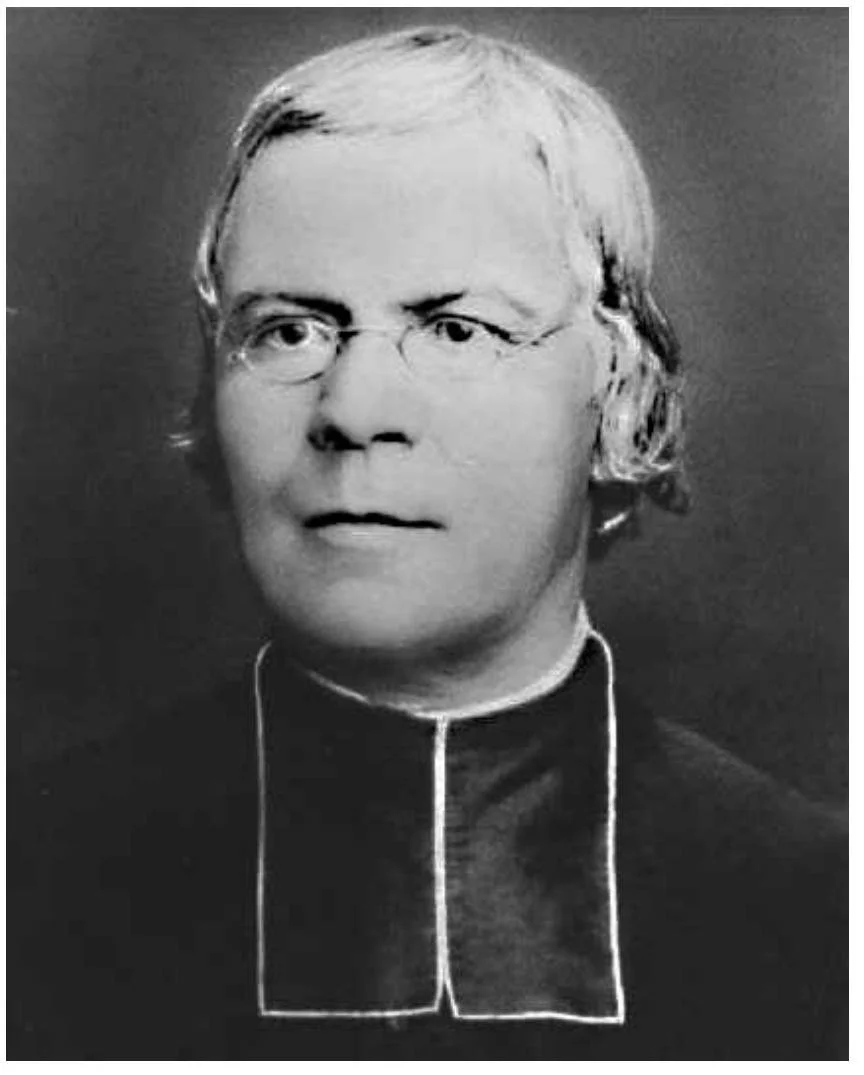
Bl. Louis Brisson, OSFS (1817-1908)

Priest, Founder of the Oblate Sisters and Oblate of St. Francis de Sales
Beatified: September 22, 2012
Feast Day: October 12
Louis Brisson was born on June 23, 1817, in Plancy, France, the only child of Toussaint and Savine Brisson. He was an inquisitive child who had a great interest in both literature and the natural sciences, especially chemistry, physics, and astronomy. After a basic education by a local priest, he entered the diocesan seminary and was ordained a priest of the Diocese of Troyes on December 19, 1840.
Fr. Brisson was assigned to teach science at the Visitation Monastery School in Troyes. He was known as a gifted teacher who enjoyed communicating the wonders of the natural world to his students. Fr. Brisson later became the confessor and chaplain to the Sisters of the Visitation in Troyes, a position he would hold for the next forty-one years. It was during this time that he met the woman who would be his spiritual mentor and inspiration: Venerable Mother Mary de Sales Chappuis, VHM, superior of the Troyes Monastery.

Widely known for her mystical prayer life, concern for the marginalized, and ability to communicate and teach Salesian Spirituality, Mother Chappuis began to slowly teach Fr. Brisson about Salesian Spirituality, specifically the Spiritual Directory of St. Francis de Sales, a small book of spiritual practices designed to assist the individual in remaining in God’s presence throughout the day. At the same time Mother Chappuis and Fr. Brisson began working to reform French Catholicism through their participation in the Association of St. Francis de Sales, a European network dedicated to foster a renewal of the Catholic faith and its practice throughout the continent. The Association was established in Troyes in 1857 with Fr. Brisson as its director and Mother Chappuis as its treasurer.
Through this work, Fr. Brisson became concerned about young women who had come to Troyes seeking jobs in the city’s many factories. Due to the Industrial Revolution, Troyes had become a city that specialized in the textile industry. The young women who came to work in the factories met with deplorable working and living conditions, lack of necessities, and a loss of religious practice. Fr. Brisson established shelters for these young women which provided them with lodging, food, safety, and the ability to once more practice their Catholic faith. While he originally entrusted the operation of the shelters to volunteers, Fr. Brisson soon realized that more competent staffing was needed. In 1866, together with Leonie Aviat, a graduate of the same Visitation monastery school where Fr. Brisson ministered, he founded the Oblate Sisters of St. Francis de Sales to care for these young women and provide them with religious education and support.

Throughout his ministry, Fr. Brisson continued meeting and collaborating with Mother Chappuis. In one of their meetings, Mother Chappuis revealed to him that she believed God had called Brisson to create a community of men who, formed by the Spiritual Directory, would continue the pastoral ministry of St. Francis de Sales. For a variety of reasons, Brisson was strongly resistant to the idea of founding a male congregation as envisioned by Mother Chappuis. It was not until the Lord Himself appeared to him in the parlor of the Troyes Visitation monastery on February 24, 1845, after a heated discussion with Mother Chappuis, that Brisson finally acquiesced. However, it was another thirty years before the Oblate priests and brothers were founded, fulfilling Mother Chappuis’s lifelong desire. On October 12, 1873, Fr. Brisson and six contemporaries received the habit of the Oblates of St. Francis de Sales and began a two-year novitiate period of prayer and formation in the consecrated life. In 1875, Fr. Brisson received the official papal decree granting the Oblate congregation its first charter and placing it under the direct and immediate jurisdiction of the Holy See. In 1876, Fr. Brisson and his companions pronounced their first vows as Oblates of St. Francis de Sales.
The new community devoted itself to education, pastoral work, and the foreign missions. The Oblates grew rapidly and spread from France to South Africa, Namibia, Ecuador, England, Austria, Italy, Brazil, and the United States. In the early 1900s, the French government began a program of secularization which resulted in the closing of many religious houses and institutions, including the shelters for young women and religious schools established and staffed by the Oblates. Many of the Oblates left France and continued to establish the congregation outside of the country. Because he was too old to travel, Fr. Brisson returned to his family home in Plancy and remained there until his death on February 2, 1908, with Mother Leonie Aviat, OSFS, and other Oblate priests at his side. Fr. Brisson was beatified on September 22, 2012.
From their humble beginnings, the Oblates of St. Francis de Sales became an international congregation with religious houses in North and South America, Europe, and Africa. Mother Chappuis and Fr. Brisson’s vision for a religious order of men to serve the church just as St. Francis de Sales did continues up to the present day.
Read more about Blessed Louis Brisson:
“Respect the Soul of Your Students” by Blessed Louis Brisson, OSFS
“Blessed Brisson” by Fr. Alexander Pocetto, OSFS
“Another ‘Special’ Prayer” by Fr. David Whalen OSFS

The above reflection series was written by Fr. Michael Newman, OSFS.
The Foundational Texts: The True Understanding of the Congregation According to Fr. Brisson
Texts of Fr. Brisson chosen by Fr. Roger Balducelli, OSFS, edited and revised by Dialogue With US, Common Identity Subcommittee
You can view the entire compilation below. These texts cover a variety of topics pertaining to Oblate life and are organized by these topics:
Full List of The Foundational Texts
#1 “The Oblates are called to enter society such as it is, and by all possible means.”
#2 “Do you know how vocations are formed?”
#3 “It would be impossible to recognize true vocations in a novitiate totally isolated from the world.”
#4 “With us, our strength lies with the individual, making full use of what God has given to each of us.”
#5 “The Oblate is essentially an interior person.”
#6 “The Oblate meditates to arrange his affairs.”
#7 “Love is our special bond.”
#8 “In order to be a good Oblate, one ought not to isolate oneself, acting individually.”
#9 “Let us clearly understand that we are Oblates of St. Francis de Sales.”
#10 “There are two ways of approaching our neighbor: authoritatively or persuasively.”
#11 “Understand well, my Friends, this theology of abnegation.”
#12 “Why do the Swiss only make cooked cheese?”
#13 “In the last analysis, what makes a man?”
#14 “Understand well your dignity in being your own master.”
#15 “Here is the true meaning of obedience: it is an act of true independence of the will.”
#16 “In thus obeying God, in the fullness of our freedom, we are truly a person; otherwise we are nothing at all.”
#17 “It is your duty to preside, but how are you to preside?”
#18 “The mortification of charity” and “the mortification of a good Capuchin.”
#19 “The Superior General is not established as Superior General of the Oblates of Saint Francis de Sales to do what is done everywhere.”
#20 “The great difficulty with obedience stems from the person who commands rather than with the order itself which is the object of the obedience.”
#21 “In every congregation, there is a foundational vision grounding the establishment of the congregation.”
#22 “Let us return to our origins.”
#23 “What did the Good Mother mean by the expression: The Way?”
#24 “It is imperative that we be apostles of the Gospel.”
#25 “From our education, we have fake notions of mental prayer.”
#26 “Firm up your principles: what is evil is evil and can never become good.”
#27 “There are some who do not feel obliged to be charitable toward their Superiors.”
#28 “The motto for all our works ought to be: ‘Do well and let them talk!’”
#29 “It is absolutely necessary to determine the true meaning of the Good Mother’s words.”
#30 “To be abreast with our age, we must have contact with workers.”
#31 “We need to get out of the rut!”
#32 “The precept of charity well understood ought to inspire in us respect for one another.”
#33“Individualism: each one stays in his own little corner; each one remains in his own little house.”
#34 “God has desired of you all that you have done in your work.”
Suggestions for Further Reading