

St. Joseph: A Role Model for Living Jesus
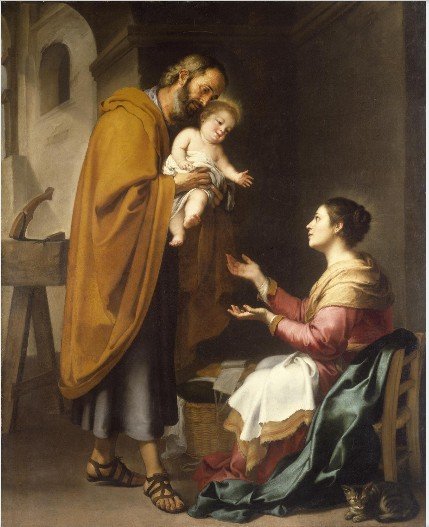
Bartolomé Esteban Murillo (1617-82), The Holy Family of Jesus, Mary, and Joseph, late 1640s, oil on canvas. National Gallery of Ireland, Dublin. Purchased 1962 (Shaw Fund). (photo: Public domain, via Wikimedia Commons)
Perhaps we’ve heard it said, or maybe even said it ourselves: “The Bible doesn’t tell us much about St. Joseph!” Approaching the Bible in this way can run the risk of making it something other than what it is. The Bible is unlike any other book: it is the Word of God.
Erich Auerbach—a pioneer in the field of Comparative Literature—demonstrates in his masterwork, Mimesis: The Representation of Reality in Western Literature (first published in 1946, with many subsequent editions and translations), that unlike the great epics of classical Greece and Rome, which explain everything in great detail and leave nothing unsaid or unknown, the Bible provides neither back stories nor answers to all the questions about which we may be curious. This is because the Bible’s primary purpose is to proclaim God’s salvific action in human history, which He shapes into salvation history. Persons and events are significant only insofar as they are part of God’s purpose and action.
The Gospels invite us to see Joseph of Nazareth from God’s perspective. Viewed in this way, it is possible to uncover a very rich spiritual portrait of St. Joseph, as indeed many saints have done, including Bernard of Clairvaux, Teresa of Ávila, and Francis de Sales. Closer to our own time, Pope Leo XIII, Pope St. John Paul II, and Pope Francis have appealed to the Gospel portrait of Joseph as the source and organizing principle for major papal documents dedicated to the saint which aim, among other things, to convey his indispensable role in human salvation as the man whom heaven trusts.
On this Solemnity of St. Joseph, we might consider what John Paul II called “the core of biblical truth about Saint Joseph”: “There is a strict parallel between the ‘annunciation’ [to Joseph] in Matthew’s [Gospel] and the one [to Mary] in Luke” (Guardian of the Redeemer, Apostolic Exhortation, 15 August 1989, nos. 2-3). At his annunciation (Matthew 1:18-25), Joseph is called to be Jesus’s disciple by being His father on earth. Joseph’s mission is not primarily about something, but rather a person: the Son of God. From this moment on, Jesus and Mary are the sole focus and driving force of Joseph’s life.
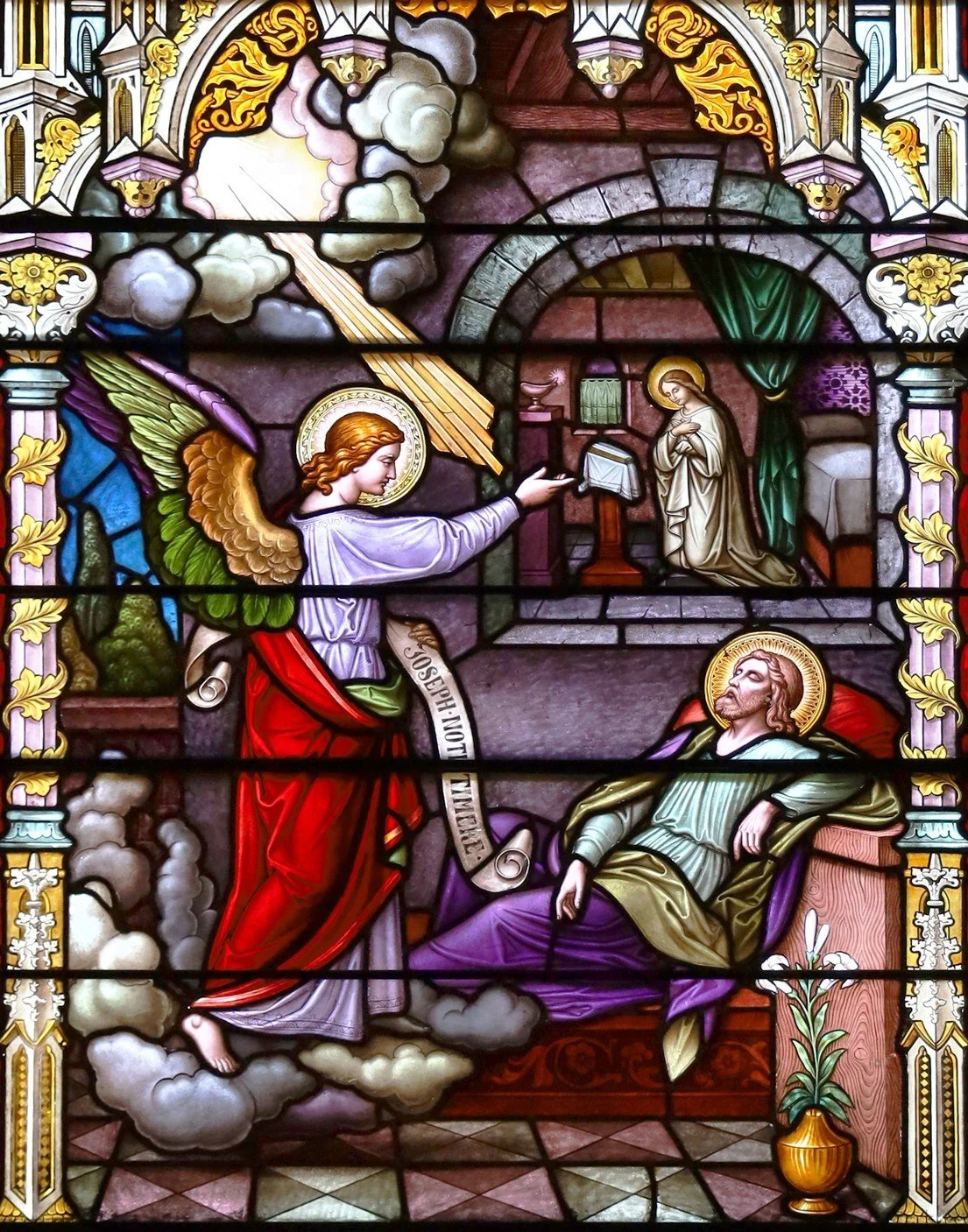
The Angelic Annunciation to St. Joseph (detail), 1891, stained-glass window, designed by Wilhelm Lamprecht and manufactured by John Morgan & Sons, New York. Chapel of Saint Joseph of the Sacred Heart, Motherhouse of the Sisters of St. Joseph, Chestnut Hill, PA. (photo: courtesy Fr. Larry Toschi, OSJ)
Joseph’s vocation stood in stark contrast to the paternalistic culture of Israel, in which a man was always the epicenter. Joseph freely surrendered his cultural status, to make Jesus and Mary the focal point of his life. According to Francis de Sales, and confirmed by modern popes, Joseph’s vocation and mission brought him closer to Mary and Jesus than anyone else in salvation history. Being the husband of the Mother of God and “having the place of God the Father for the Son of God on earth” (Francis de Sales, Sermon Plan for the Feast of St. Joseph, 1612), Joseph lived in singular intimacy with Jesus and His Mother.
For Francis, another salient feature of Joseph’s discipleship was his exemplary practice of the “little virtues which our Savior has set forth for our care and labor” (Introduction to the Devout Life, Part 3, Chapter 2), particularly humility, gentleness, patience, constancy, courage, and perseverance. In fact, Francis devoted an entire sermon to the topic of “The Virtues of St. Joseph” on March 19, 1622. It is one of the most famous sermons ever preached on the saint.
The Gospels record only one word spoken by Joseph, who is designated by God to be the first person to publicly pronounce the holy name of Jesus: “‘[Mary] will bear a son, and you are to name him Jesus, because He will save His people from their sins’” (Matthew 1:21). Centuries later, the sacred name of Jesus would be decisive in the resolution of the debilitating temptation to despair of his salvation that afflicted the teenage Francis de Sales during his student days in Paris. Francis’s discovery of Jesus as “He-who-saves” marked a turning point in surmounting this temptation, while setting the direction of the rest of his life, most especially his ministry as a priest and bishop.
Joseph of Nazareth’s inspiring example of discipleship, unreserved gift of self in the service of human salvation, and living the divine mystery in communion with Jesus and Mary is as timely today for the Church, human society, and those who aspire to “live Jesus,” as it was at the dawn of the new covenant.

Fr. Joseph F. Chorpenning, OSFS
Chair of the International Commission for Salesian Studies (ICSS)

Fr. Chorpenning is Chair of the International Commission for Salesian Studies (ICSS) and has published extensively on St. Francis de Sales’s sermons and writings on St. Joseph and the Holy Family. His book, “Saint Joseph and the Carmelite Reform of Saint Teresa of Ávila: Father, Teacher of Prayer, Intercessor in Every Need,” was published by The Catholic University of America Press and is available to purchase from Catholic University of America Press, as well as from Amazon and Barnes & Noble.


